
FOR INVESTORS
The robots got funded. Testing them didn't.
Every robot has to be proven in simulation before it touches the real world. The tools that do it need a specialist. We built one your whole team can drive.
MARKET CONTEXT
The market is moving fast.
Public, third-party numbers. None of these are ours — our figures go to investors in diligence, not onto a marketing page.
- $18.8B1
- RAISED BY ROBOTICS STARTUPS IN SIX MONTHS
- 542,0002
- NEW INDUSTRIAL ROBOTS INSTALLED IN 2024
- 88%3
- OF AI PILOTS NEVER REACH PRODUCTION
- $5T4
- PROJECTED HUMANOID MARKET BY 2050
More than all of 2025, and more than the 2021 peak — with half of 2026 still to run.
4.66 million are now running worldwide. Annual installs are forecast to pass 700,000 by 2028.
They stall on integration work and engineering hours — not on the model. That is the cost simulation removes.
Morgan Stanley's long-range estimate. Goldman Sachs models $38B by 2035.
THE PROBLEM
Simulation is where robot projects stall.
The tools need an expert
The best simulators are free and powerful. They also need someone who can hand-write robot files and tune physics. Most teams have one or two of those people. Simulation gets stuck behind them.
The cost isn't the physics
Physics is close to solved and mostly free. The cost is everything around it — building the scene, preparing the 3D models, wiring up sensors, running the tests, reading the results. Months of engineering, on every project.
The gap kills the project
A robot that works in simulation and fails on the warehouse floor sends the team back to hardware, where every attempt is slow, expensive and sometimes destructive. That's what ends pilots — not bad models.
THE THESIS
Four things we believe.
The workflow is the moat, not the physics.
NVIDIA and DeepMind are giving the physics away for free. We don't compete with it — we sit on top of it and own the part nobody has solved: making it usable by an ordinary engineer on an ordinary afternoon.
Demand grows with teams, not with robots.
Every robot takes months of testing before it ships, and more after every update. The number of teams building robots is growing far faster than the number of robots. Sell to the builders.
Plain English is what finally makes this work.
Describe an aisle, a lighting condition or a specific failure in one sentence and get back a real, editable, physics-accurate scene. That wasn't possible three years ago. It removes the single biggest time cost in the job.
Own the testing, own the deployment.
Teams that build and test in one place ship from that place. Run history, asset libraries and the bridge to real hardware make leaving expensive — quietly at first, then permanently.
WHY NOW
Four things changed at once.
- 01
Physics got fast and cheap
Running thousands of simulations in parallel turned months of training into hours. In December 2025 a Berkeley team taught a humanoid to walk in 15 minutes on one gaming GPU.5
- 02
The stack opened up
The core robotics and physics software is now open source. A new company no longer has to build a physics engine to be credible, so the whole budget goes to the product instead.
- 03
The customers arrived
Thousands of newly funded robotics teams now need somewhere to test, and most have no simulation expert on payroll and no plans to hire one first.1
- 04
The capital came to us
Qatar's sovereign fund backed Apptronik's $520M round and grew its fund-of-funds programme to $3B. We are building where that money already lives.6
THE PRODUCT
Shipped, not slideware.
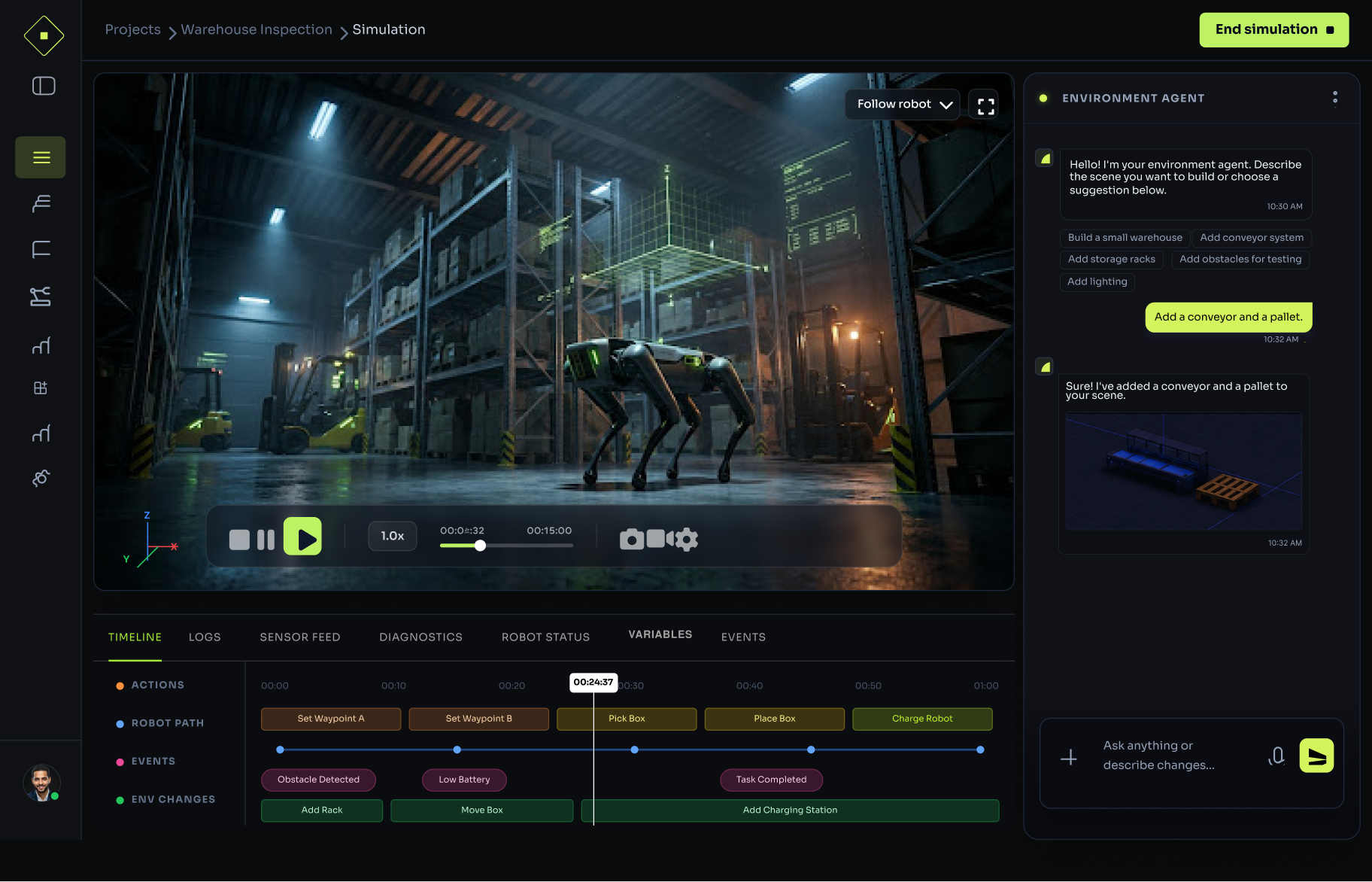
A working platform in early access, not a roadmap. What a design partner gets on day one:
- Build 3D scenes by drag and drop — no code
- Drop in ready-made robots: wheeled, armed, four-legged
- Run, rewind, replay and compare every test
- Live data showing what the robot actually did
- Describe scenes and behaviours in plain English
- Push a validated workflow to real hardware
- Run in our cloud, or entirely inside your network
WHERE WE ARE
Early access, deliberately.
We onboard design partners from a private waitlist instead of opening self-serve signup. Sitting inside a handful of real robot programmes while we build is worth more right now than a signup graph.
We publish no numbers of our own on this site. Investors get them in diligence, under NDA, with the underlying data behind them.
- Stage
- Early access, private waitlist
- Headquarters
- Doha, Qatar
- Engineering
- Tunis, Tunisia
- Built on
- ROS 2 and open standards
BUSINESS MODEL
Three ways we make money.
- 01
Seats
A subscription per engineer. It lands with the two people already doing simulation and spreads across the team as the skill barrier drops — which is the whole point of the product.
- 02
Compute
Metered simulation and training runs. Usage grows with the customer's own work rather than with our sales effort, so we earn more only when they get more.
- 03
Enterprise
Private deployments for teams whose robot designs cannot leave their network, with custom hardware support. Slower to sell, much larger, much harder to leave.
Pricing stays private during early access. Current design-partner terms are in the data room.
WHY HERE
Doha and Tunis are an advantage.
Doha
Qatar — headquarters, capital and customers
Qatar is putting sovereign money directly into physical AI, and Gulf logistics, energy and construction are buying robots on the same timeline. Being resident inside that ecosystem is a capital and customer advantage competitors have to fly for.6
Tunis
Tunisia — engineering
Tunisia sends roughly 10,000 technology graduates a year into a sector already employing over 100,000, and loses most of its senior engineers to Europe. We hire the ones who would rather stay. The same round buys us far more engineering than it would anywhere our competitors hire.7
USE OF CAPITAL
What the next round buys.
- Accuracy
- Better sensors, better handling of how objects collide and grip, and the tests that prove it. If a result isn't trustworthy, nothing else on this page matters.
- Coverage
- More robots and assets in the library, so a team's actual hardware is there on day one instead of after two weeks of integration.
- The hardware bridge
- A hardened path from tested simulation to running robots, with automatic re-testing on every change.
- Design partners
- A small commercial team to turn waitlist demand into paid partnerships across warehouse, inspection and research.
WHAT HAS TO BE TRUE
The bear case, written by us.
Break any of these four and the thesis breaks with it. Better you interrogate them now than in month nine of diligence.
The results have to be trustworthy
An easy interface on mediocre physics is a toy. We hold ourselves to whether a robot trained in our simulator works on real hardware — not to screenshots.
NVIDIA could move up the stack
They have every reason to make their own tools easier to use. Our answer is to stay neutral across engines and hardware, and own the workflow rather than the engine underneath it.
Robotics sells slowly
Buying decisions here run in quarters, not trial signups. We plan capital around that instead of assuming software speed and running out of room.
Early access has to convert
Waitlist interest is not revenue. The number that matters near-term is paid design partners renewing, and that is what we manage the company to.
If this is your thesis too, let's talk.
We share the full data room — architecture, roadmap, design-partner pipeline and current numbers — with investors under NDA. Email us and we'll come back with materials and a time.
Sources
- 1.Crunchbase News, “Robotics Startups On Fire As Venture Funding Surges To Record Numbers In 2026” (June 2026)
- 2.International Federation of Robotics, World Robotics 2025 — “Global robot demand in factories doubles over 10 years”
- 3.IDC, reported by CIO — “88% of AI pilots fail to reach production”
- 4.Morgan Stanley, “Humanoid Robot Market Expected to Reach $5 Trillion by 2050”; Goldman Sachs, “The global market for humanoid robots could reach $38 billion by 2035”
- 5.Seo, Sferrazza, Chen, Shi, Duan & Abbeel, “Learning Sim-to-Real Humanoid Locomotion in 15 Minutes”, arXiv:2512.01996
- 6.Qatar Investment Authority fund-of-funds expansion; QIA participation in Apptronik's $520M round; Qai–Brookfield AI infrastructure venture
- 7.Tunisia Investment Authority, ICT sector profile
Figures cited on this page are public third-party estimates and are not RoboSim AI data. Statements about our product, roadmap, market opportunity and business model are forward-looking and subject to change. This page is for information only. It is not an offer to sell, or a solicitation of an offer to buy, any security.